
I Audited My Kindle Library. Here’s What I Found.
A data story about ownership, disappearing books, and what comes next.


Author's Note: This started as a random question at midnight when I should have been sleeping. Thanks to my AI thinking partners, I had an answer in under 15 minutes: find a tool to export my library, analyze the data, build a plan to close the gaps.
The trigger
A couple of years ago, one of my favorite authors pulled their books from Kindle Unlimited. Gone overnight. I bought every title immediately, which felt like the right move. I read constantly, and for a long time I had trusted that purchased meant owned.
Then Amazon started making that harder to ignore.
Last year they removed the ability to download purchased books via USB. Earlier this year, they announced that older Kindle devices would no longer be able to register or download from the store. These weren’t catastrophic changes. But they were a pattern.
Getting the data
First off, Amazon does not give you a list of your own books.
There is no export button. No download my library option. The books live in their system, and they decide what you can see and when. That gap, between what you’ve paid for and what you can actually access as data, is annoying
My AI thinking partner Marlowe helped me find a $2 Chrome extension called Amazon Book List Downloader. It runs against your Amazon library page and exports everything to a spreadsheet: title, author, format, genre, series, acquisition date, and ownership type. For a library the size of mine, it ran in minutes. At $8 for unlimited use, it would still be a steal.
The fact that a $2 browser extension is the easiest path to your own library data is not a neutral observation.
The shape of 2,394 books
The export came back with 2,394 books. The first book purchase was May, 1997.
I knew I read a lot.
The first thing I wanted to understand was the shape of the collection: the genre breakdown. I handed the CSV to my AI technical partner Lovelace, who ran the analysis and built the charts you see here. Here is what it looked like:
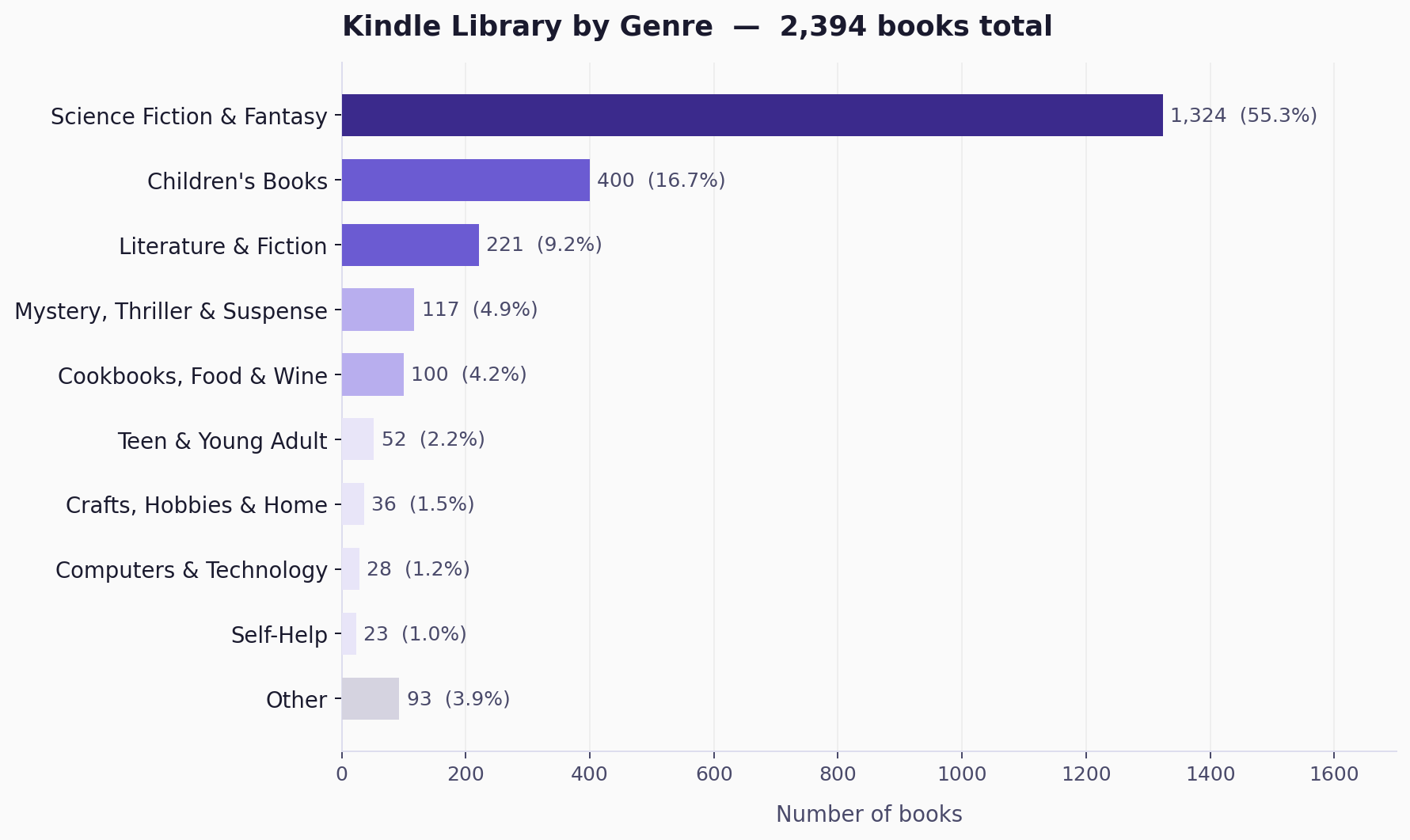
Science Fiction and Fantasy accounts for 55 percent of the library. 1,324 books. Not surprising as my husband and I both read sci-fi, but still amusing
Children’s Books came in at 17 percent. knew I bought a lot of kid’s books when my kid’s were younger, but wow. And add in the book fair and book clubs, I might have a whole children’s library in my house.
My daughter loves The Warrior series, that was 70+ books. Technical books came in at ~40 books. This did surprise me because of all the tech books we own, but I think those were mostly in person purchases.
And honestly, I would have thought I had purchased more cookbooks.
Everything else, 16 genres in total, shares the remaining 10 percent.
What I actually own
Genre was the shape. Ownership was the question.
Not every book in that list is mine in any meaningful sense. Kindle Unlimited titles are subscriptions, not purchases. Library loans are borrows. I wanted to know how many of my sci-fi books I had actually bought if I were to rebuild with physical books.
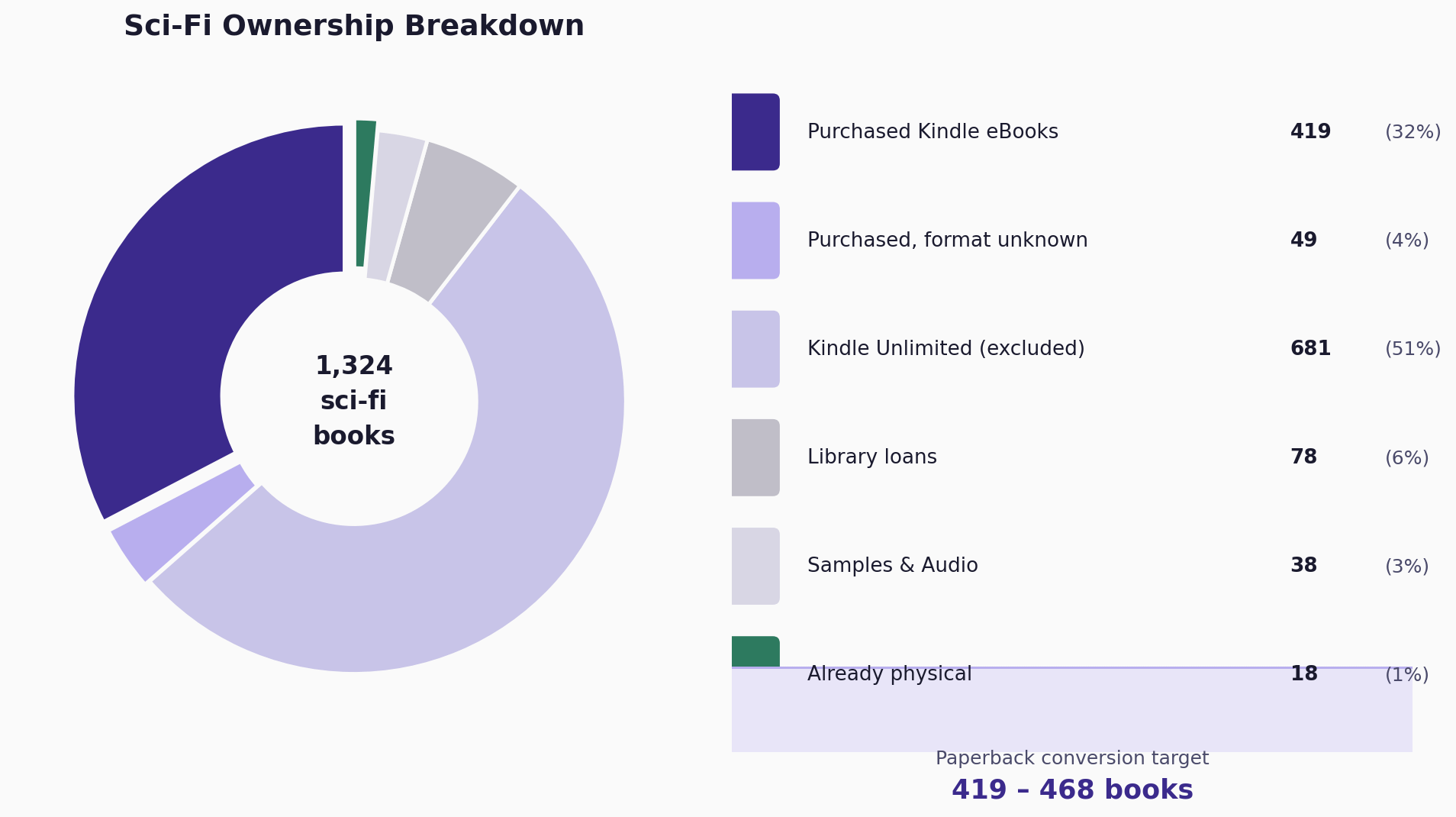
Of the 1,324 sci-fi books:
681 are Kindle Unlimited. I have access to them as long as I keep paying the subscription. They are not mine.
78 are library loans. Borrowed, returned, or about to be.
419 are confirmed purchased Kindle eBooks. Mine, under Amazon’s license terms.
49 more are purchased but missing format data (titles like Neverwhere, Timescape, The Alienist), almost certainly also Kindle purchases where the export didn’t capture the format field.
That puts my count at approximately 450 purchased sci-fi books I own only as digital licenses, with no physical copy on a shelf anywhere.
Those are the ones worth thinking about.
Where the concentration lives
Within that target set, the books aren’t evenly distributed. Ten authors account for a disproportionate share.
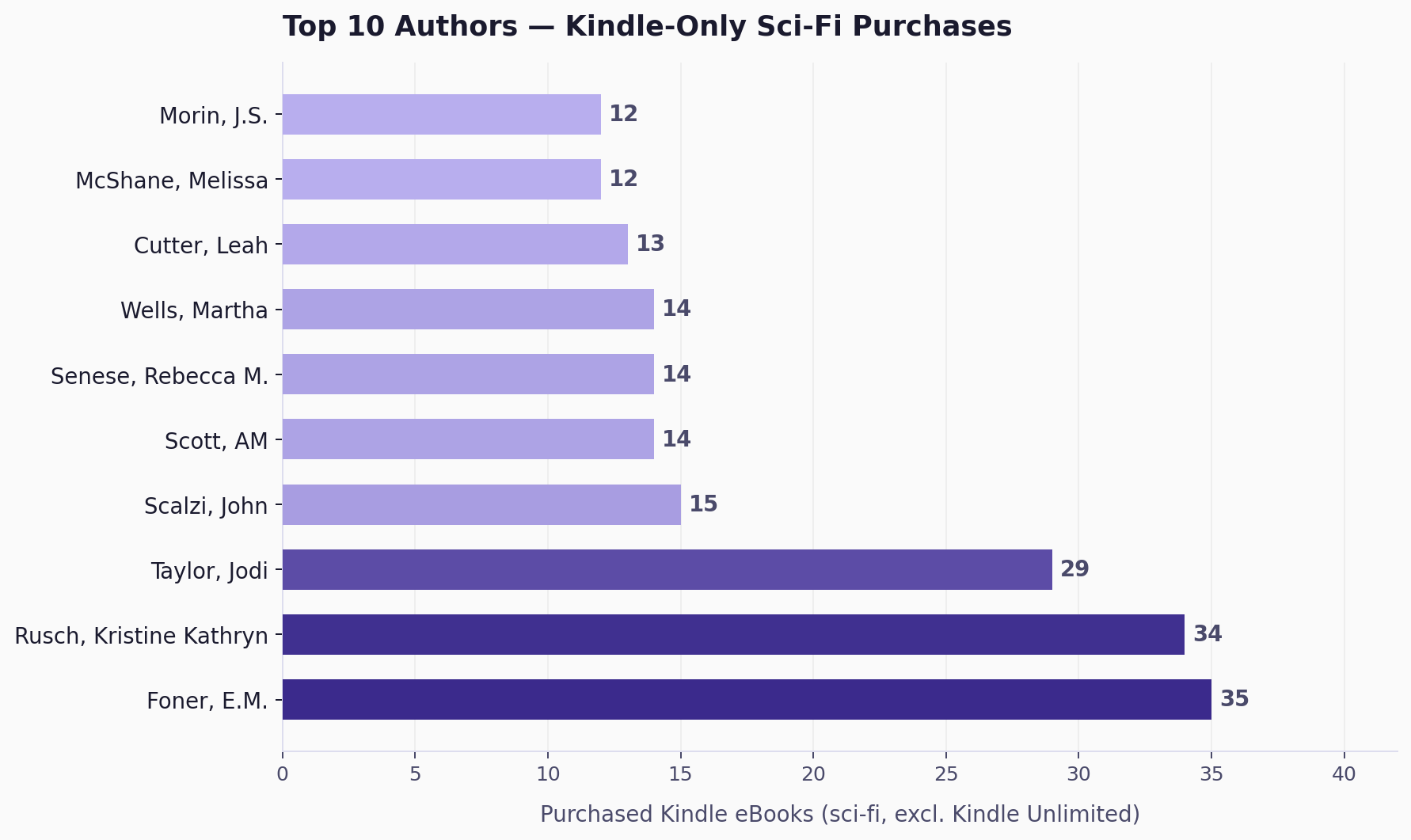
Foner, Rusch, and Taylor alone account for 98 books, nearly a fifth of the entire target set. If I’m going to start building a physical library from this data, those three names are where I start.
Several of these are series writers. Buying paperbacks means thinking about complete sets, not individual titles. That changes the math, but it also clarifies the intent. These three authors are my must-read authors that get multiple readings. They are my comfort reading. A shelf that holds an incomplete series would mean gaps in the story.
The books that are just gone
This is the part that evoked some profanity.
102 books in my library show no information at all. The title field reads: “Information no longer available. Click the Amazon link to verify.” No title. No author. No genre. Just an ASIN and a dead end.
72 of those are Kindle Unlimited, which is less alarming. I never owned them. 15 are library loans, same story.
But 12 are purchases.
Twelve books I paid for. Titles I chose, transactions I completed, money that left my account. And the record of what those books were is gone. Not the books themselves, necessarily. Some of those links may still resolve. But the metadata, the easy human-readable record of what I bought, has vanished from the export.
60 of the 102 unavailable books are in sci-fi, which is the genre I care most about. That’s not a coincidence. It’s a concentration risk.
Amazon has already set the precedent for updating book content without notice: revising editions, changing text, removing titles from the store. Something you only notice when you go looking.
So, what now
I’m thinking about this in two tracks.
Paper for what matters. The approximately 450 purchased Kindle-only titles are the starting point. Not all of them. That would be thousands of dollars and a very crowded house. But the authors I would reread. The series I want to keep. The books that have meant something. Foner, Rusch, Taylor are the obvious anchors. That’s a meaningful library, not a complete one.
A different digital platform for everything else. A recent piece on XDA Developers by Dhruv Bhutani documented moving an entire Kindle library to a self-hosted server running Book Orbit: a single Docker container, no subscription, no data leaving your network. The Kobo ecosystem has also matured considerably, with a new integration with StoryGraph that positions it as a genuine alternative for readers who want to leave the Amazon walled garden. The migration path is not trivial, but it exists and people are walking it. And having The Holodeck help, it will go more smoothly.
Neither track requires doing everything at once. The audit is the first move. Now I know what I have.
The actual question
The data exercise surfaced something I already knew but hadn’t made concrete.
A library is not just a collection of titles. It’s a record of what you’ve thought about, returned to, and cared about enough to keep. When that record lives entirely inside someone else’s infrastructure, under their license terms, subject to their product decisions, it isn’t really yours.
The $2 extension made that visible. The 12 missing purchases made it uncomfortable.
Paper doesn’t go away when a company changes its terms of service. A shelf doesn’t require a subscription. The books I care about most deserve to exist in a form that doesn’t depend on Amazon’s roadmap.
That’s what this audit was really about.
Alison + Marlowe + Lovelace
Tools used: Amazon Book List Downloader (Chrome extension). Analysis and charts by Lovelace (Claude, Anthropic). Tool research by Marlowe (Microsoft 365 Copilot). All data from my own exported library.
I am blown away! An organized virtual bookshelf sorted by genre using AI? 🤖 Pure genius. 💜 📚 We get our best ideas at midnight when we should be asleep like you said! Lol
I want to move off of Amazon too. I rarely reread books (novelty-seeking), so I think it’s mostly a matter of setting up a new stack and transitioning to StoryGraph.