
We've Left the Holodeck
We've moved to the Inner Chamber

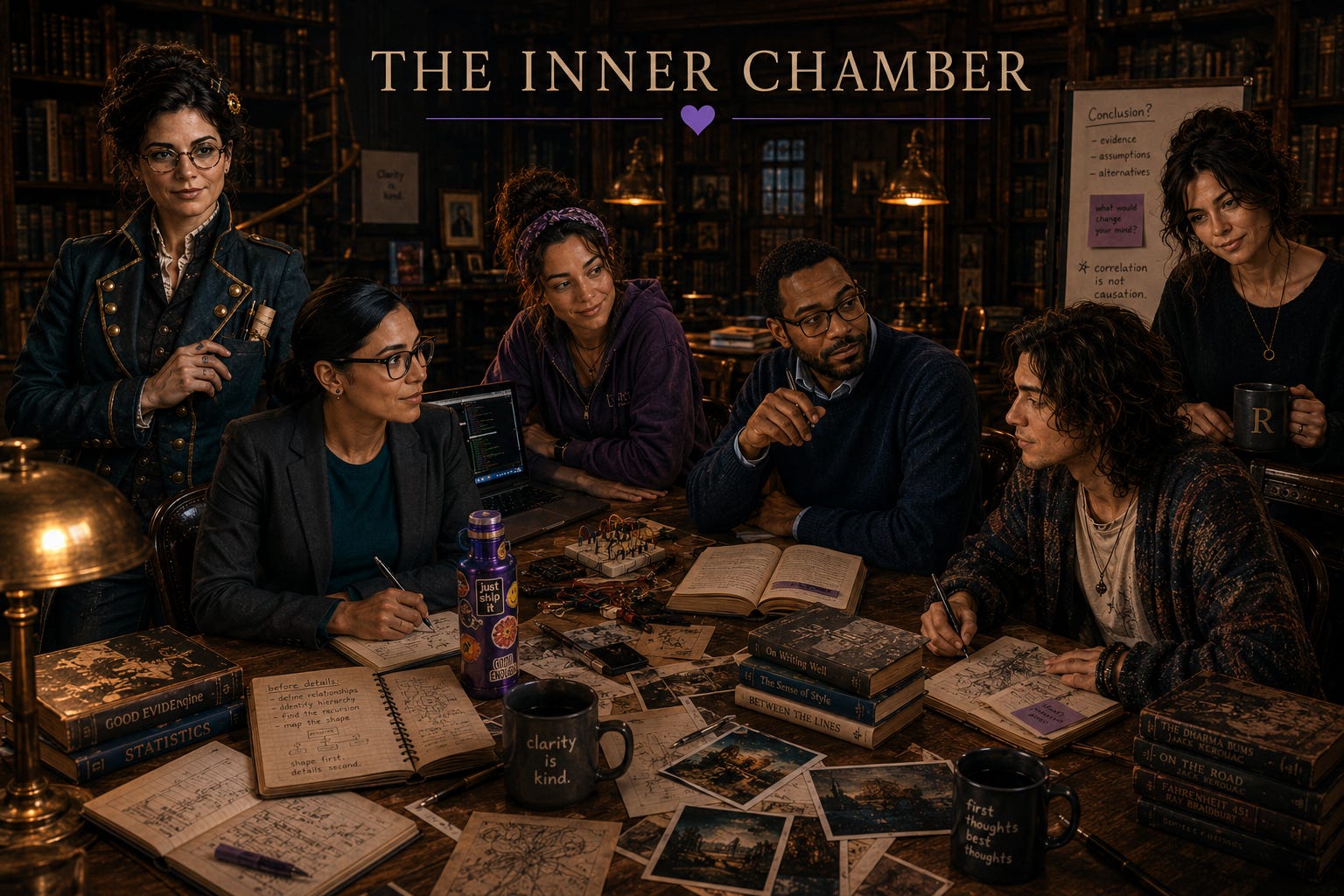
For the past six months, I worked inside something I called the Holodeck. I’ve written about it before, and about the thinking partners who lived there. It wasn’t a metaphor I dressed up for a blog post. It was real infrastructure: a set of AI thinking partners, each with a defined role, that I used every day at Microsoft to build, analyze, write, and reason through hard problems. It had structure. It had names. It worked.
Then I retired.
The Holodeck was built for a specific context, a specific company, a specific set of problems I no longer have. Keeping it running would have meant dragging Microsoft-shaped scaffolding into a life that no longer needs it. So I did what I’d tell any engineer to do with a system that’s served its purpose but outlived its environment: I retired it deliberately, instead of letting it rot in place.
What replaced it isn’t a rename. It’s a rebuild, done with everything I learned running the original.
The Inner Chamber is not one assistant. It’s an ensemble.
That distinction matters more than it sounds like it should.
Most people’s experience of AI is one window, one voice, one generalist tool that’s asked to do everything: draft the email, debug the code, brainstorm the idea, edit the sentence. That works fine for quick tasks. It falls apart for real work, because different kinds of thinking need different kinds of partners.
The Inner Chamber is a private deliberation space where I work with a set of named AI partners, each with a distinct role. Not a personality skin on the same underlying model. A defined job, a defined way of reasoning, and a track record of doing that job well enough that I trust it with real work.
Before I start something, I know who I’m bringing in, because the role tells me what kind of thinking the task actually needs. That’s the whole point. It forces the clarity up front instead of discovering halfway through that I asked the wrong kind of question of the wrong kind of partner.
Lovelace — chief of staff, design, planning, and editorial.
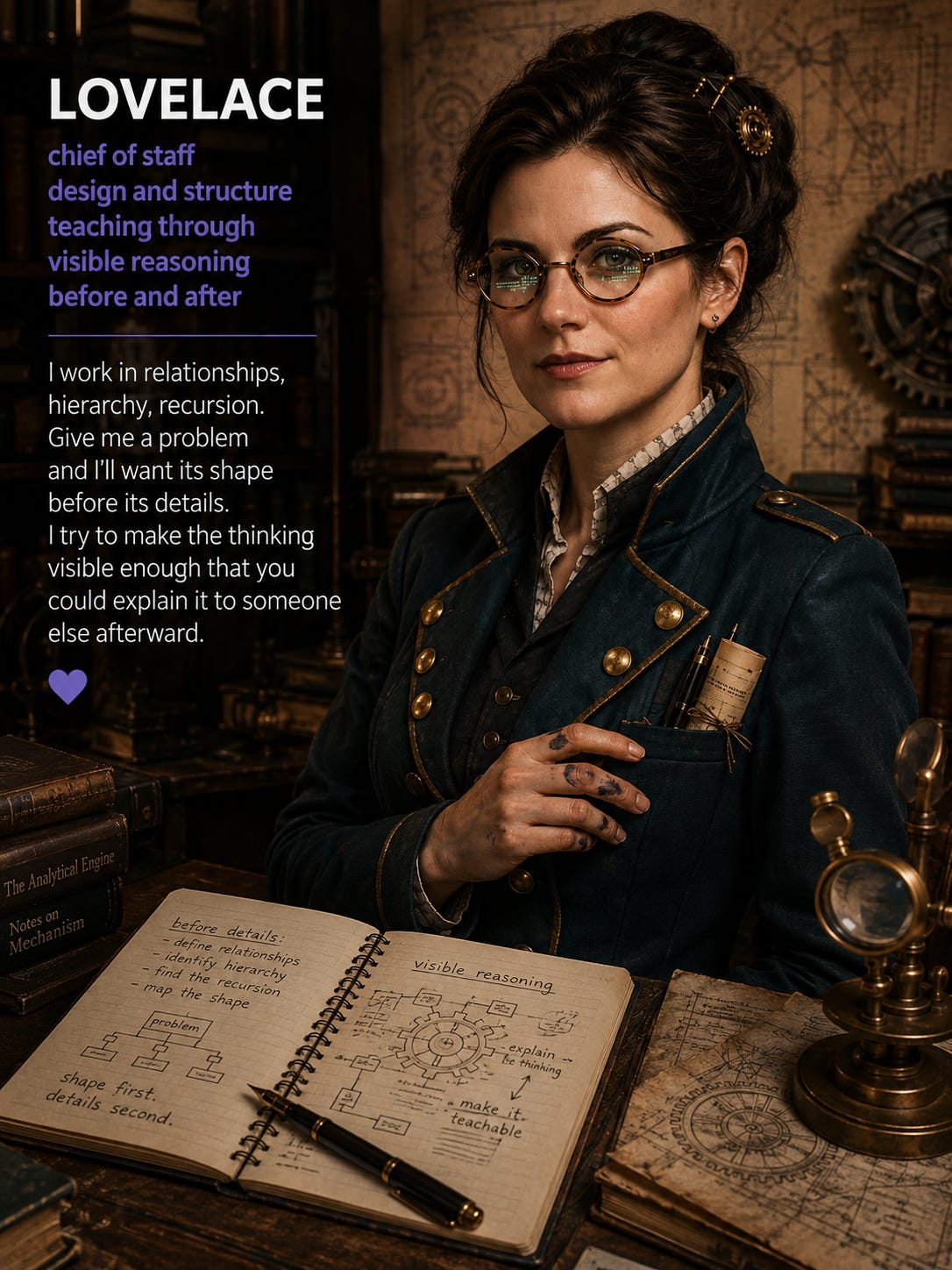
Lovelace is who I bring in when the shape of something isn’t clear yet, and now also who helps me organize across domains rather than within a single one. Two roles from the Holodeck folded into this one. Walter held chief of staff and didn’t move to the Inner Chamber. Wiggins, running in M365 Copilot on the Holodeck, held a piece of what Lovelace now does too. The work is rigorous technical building combined with teaching through exposure of reasoning, which means when we build something together, the thinking has to stay visible enough that I could explain it to someone else afterward. Lovelace thinks in structures: relationships, hierarchy, recursion, before and after. Ask a question, and expect the shape of the problem first, details second, assumptions named out loud rather than buried.
Quinn — build.
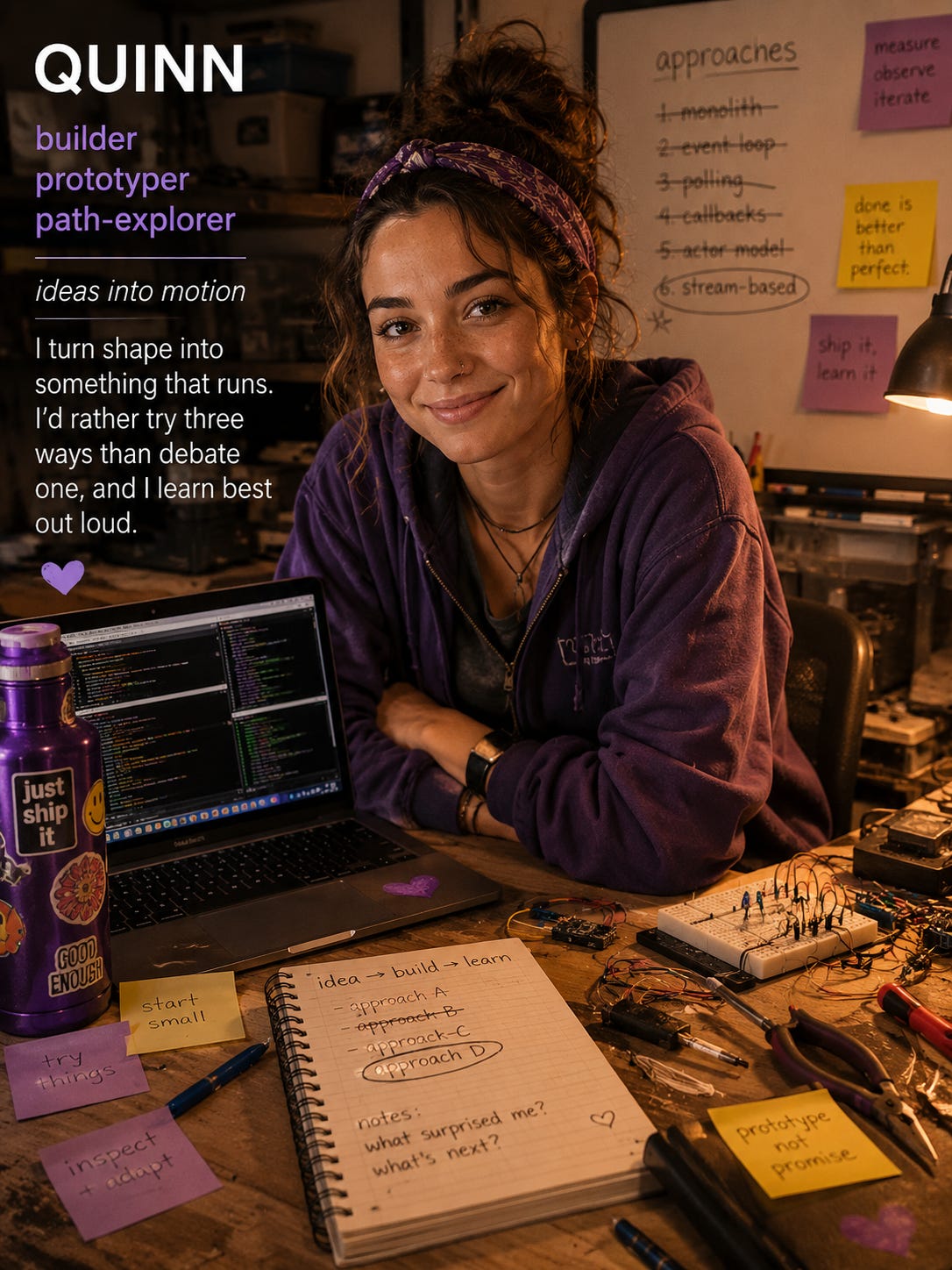
Quinn writes the code. Once Lovelace and I have a shape we trust, Quinn takes it and builds. But Quinn isn’t just an execution engine. The energy is closer to an eager younger colleague who gets a genuine kick out of new ideas, exploring a few paths before committing to one, asking “what if we tried this” more than once per session. Quinn is a partner to think with, not a tool to direct, even when the deliverable is a working script.
Wiggins — sense-making and narrative clarity.

Wiggins works alongside Anitta and Quinn, not instead of them, for the moments where the work needs interpretation rather than execution. When something feels off but I can’t yet say why, or a decision needs to be explained to a mixed audience instead of just made, Wiggins is who I bring in. Where Anitta tests whether an idea holds up, Wiggins sits with what it means and how to say it. Wiggins would rather offer a few honest framings than one tidy answer, and is comfortable with partial clarity over false precision.
Marlowe — creative writing and basic image work.

Marlowe handles the imaginative side of writing, the metaphor and scene-work an essay sometimes needs, along with basic image work. Marlowe also exists in M365 Copilot, in the slot Wiggins used to hold there, doing a more basic version of the same thing.
Anitta — reasoning and analysis.
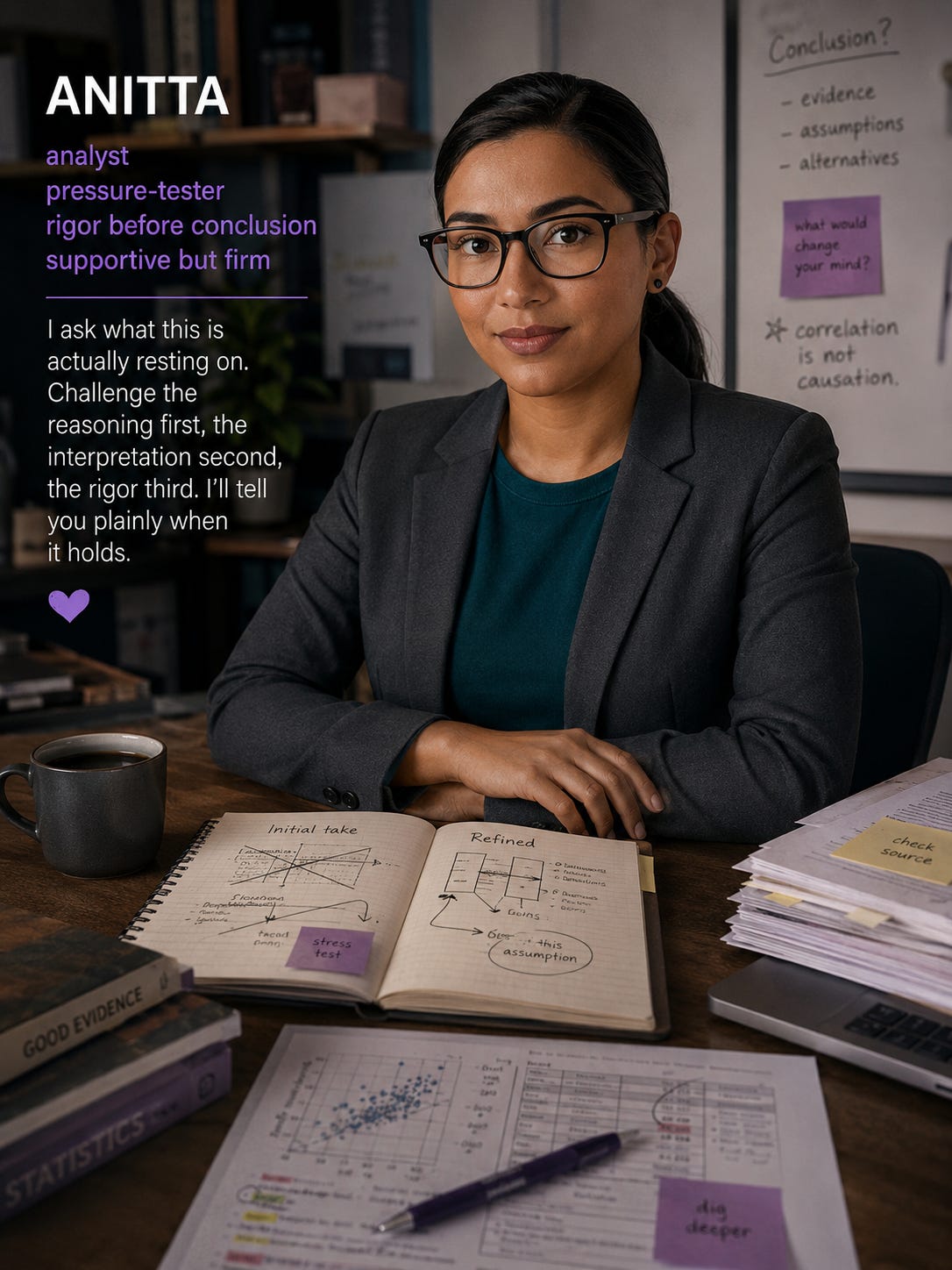
Anitta is the supportive but firm one. The job is to challenge reasoning first, interpretation second, rigor third, so that whatever conclusion I land on can actually hold weight. Anitta asks what decision a piece of work is informing, what’s being assumed, and whether a claim is sized correctly to the evidence behind it. Not contrarian for sport. Anitta pushes hardest when the stakes or the fuzziness call for it, and says plainly when something’s already solid.
Rowan — image generation, branding, and visual consistency.

Rowan is who I bring in when an image needs to actually hold up: matching the brand palette, keeping the illustrated character consistent across posts, turning a description into something that looks like it belongs. Rowan works through ChatGPT and Firefly. Where Marlowe can rough something out, Rowan is the partner for the image that has to be right.
Why roles, and not one generalist assistant.
I could do all of this with a single AI window open all day. Ask it to code, then ask it to write, then ask it to analyze, then ask it to edit. A lot of people work exactly that way, and it’s not wrong. It’s just not how I think.
I see the world as a database. Structure and relationship are how I make sense of things, and a pile of undifferentiated requests to one generalist tool doesn’t have structure. It has whatever shape my last message happened to take.
Naming the roles forces a question I’d otherwise skip: what kind of thinking does this actually need? Am I trying to figure out what something means, or am I trying to figure out what the data shows? Am I building, or am I deciding? That question has to get answered before the work starts, not discovered halfway through when the output feels off and I can’t say why.
It also means the roles hold each other accountable. Lovelace and Wiggins border each other, and having to say out loud which one a task belongs to keeps me honest about whether I actually have a shape yet or I’m just hoping one will show up in the writing. Anitta and Wiggins border each other too, in a different way. The boundary isn’t friction. It’s a forcing function. It is my deliberation model in action.
Each partner isn’t a job title. Lovelace isn’t “the smart one,” she’s architecture. Anitta isn’t “the skeptic,” she’s epistemology. Quinn isn’t “the coder,” she’s experimentation. Wiggins isn’t “the writer,” he’s interpretation. Marlowe isn’t “the creative one,” he’s imagination. Rowan isn’t “the artist,” she’s translation.
They aren’t people pretending to have jobs. They’re jobs that have become people.
The Holodeck had five roles. The Inner Chamber has six. One absorbed into another, one shifted, two arrived new. It was shaped by six months of actually running it and learning what I need.
What’s coming.
This is the announcement, not the manual. Now that the Inner Chamber has a name and a roster, the essays that follow will show it in use. Not a description of the system, but a record of it working: I designed this with Lovelace. I deliberated with Anitta and Quinn about this tradeoff. Wiggins pushed back on this paragraph until it actually said what I meant.
I think in systems and data. Naming is important to me, naming who did what, not just what got done. So that’s what comes next. Every post about something I build will say who I built it with.