
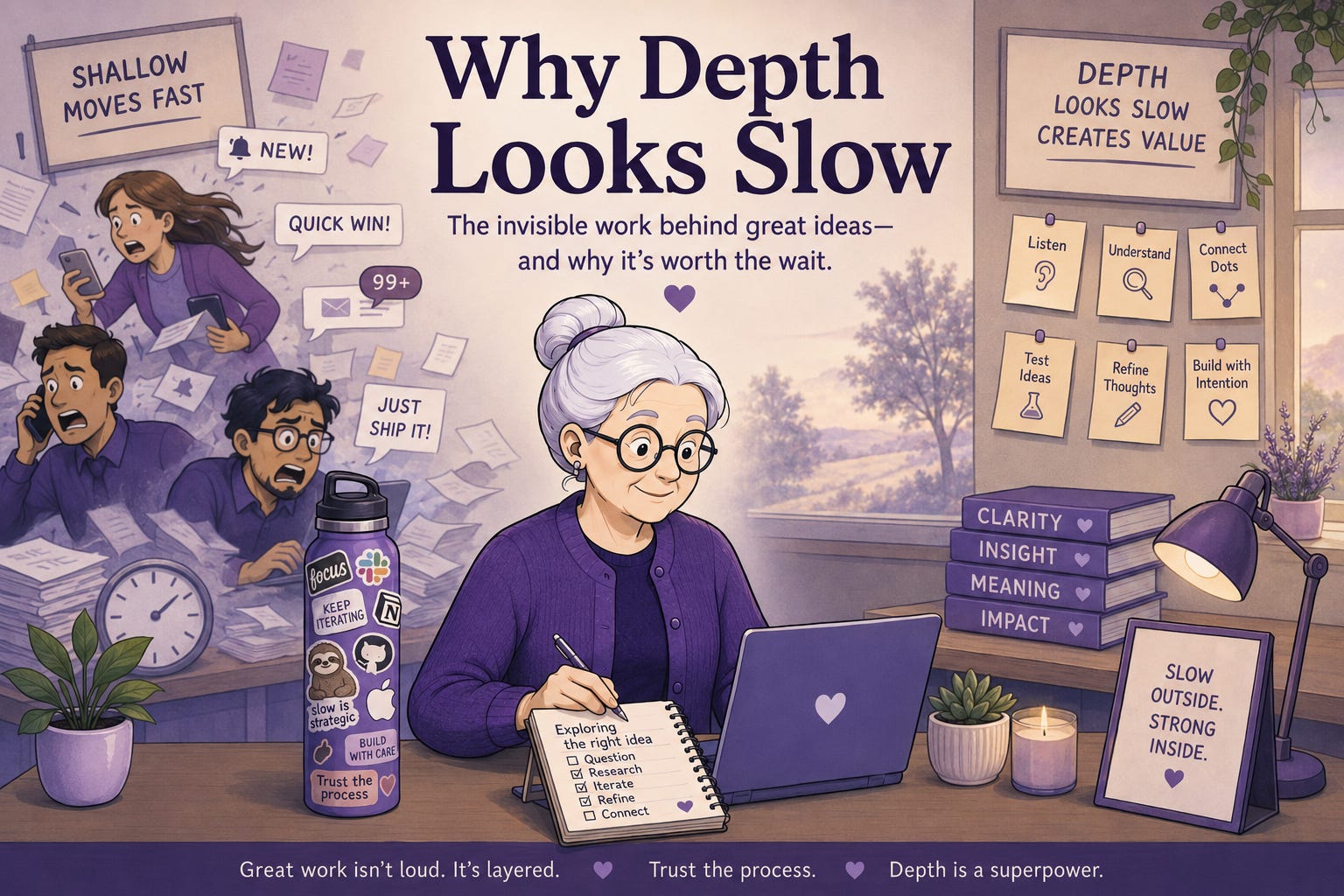
Why Depth Looks Slow
Code Like a Little Old Lady: Speed, The Micro View

Author’s Note: This was originally published on May 30, 2026 on my personal Substack.
Speed is the story everyone is telling right now. In my last essay, I wrote about how the pace of software development has changed across my career and how the definition of “fast” keeps shifting under our feet. This essay looks at speed from a different angle. Not the decades long view, but the view inside a single night of work, where depth and pace collide in a very different way.
There is a particular kind of pressure in the air right now.
Ten minutes and a prompt.
Forty five minutes and you ship.
If you aren’t moving at that speed, the implication is that you are doing it wrong.
By that measure, I had a terrible week.
I spent five hours on one part of a larger project.
Not building it.
Not shipping it.
Designing the prompt for the data layer.
Five hours, zero code.
The horns would have been honking.
I have been in tech long enough to know that the things you skip in the beginning are the things that cost you later.
The Little Old Lady From Pasadena
When I think of “code like a little old lady,” I think of the woman who drove twenty five miles an hour once a week, steady as a metronome, while everyone else swerved around her. Slow. Predictable. Unbothered.
This week, I was her.
Not because I don’t know how to move fast.
But because I was thinking in a different direction entirely.
The Work That Doesn’t Look Like Work
The project I am building is a hands on implementation of a Recursive Language Model, based on the Zhang, Kraska, Khattab paper out of MIT CSAIL. The question behind it is deceptively simple.
What becomes possible when a model can investigate a dataset instead of only reading it.
To explore that, I needed a dataset that could actually teach me something. Not a toy. Not a happy path demo. Something with enough structure and enough mess that recursive reasoning would matter.
So I designed a synthetic dataset generator.
Twenty items. Ten groups. Three to five owners each.
A baseline snapshot on January 1, 2026.
Daily snapshots through Q1.
New, Present, Removed.
A Closed table as ground truth.
Then I added the knobs.
False positives. False negatives. True positives.
Percentages of edge cases.
Seed controls.
Variations that let me generate multiple datasets for multiple scenarios.
This is the part that comes from experience. I know what a dataset must contain if I want to trust what I learn from it.
Overkill. Probably.
But the next morning in the shower, I realized one more thing I could add to make the dataset reusable across three different methods I want to compare. Not just the generator. The data itself.
That was the moment I understood what had actually happened.
The Holodeck and the Questions That Stop You
I wasn’t working alone. I was working with my AI thinking partners, a small group I call the Holodeck. Each one has a role. Writing. Analysis. Building. Technical reasoning. They weren’t speeding me up. They were slowing me down in the right places.
“How many items per group.”
“Is this event style or daily emit.”
“What is the difference between the date the row closed and the date the snapshot first saw it was gone.”
That last one stopped me cold.
Because those dates aren’t the same, even if they look the same.
And if I hadn’t been asked, I would have collapsed them.
Every question saw me saying either
I didn’t think of that yet
or
I knew that, I just didn’t include it.
Both kinds matter.
By the end, the data generator was more reusable than I intended. The architecture was clearer. The reasoning paths were sharper. The project itself had more surface area for learning.
None of that would have emerged in forty five minutes. And it didn’t feel like five hours, the time flew.
Speed Is Relative
People talk about speed as if it is an absolute.
It is not.
Speed is relative to others on the road.
Last week, I was on an open highway.
I didn’t notice the speed until I looked up.
What I was doing wasn’t slow.
It was deep.
Depth doesn’t show up on a speedometer.
Why I Code Like a Little Old Lady
I don’t build only for the happy path.
I build for the wicked forest around it.
The point of this project isn’t only to produce an RLM.
It is to understand something about how models reason, how data shapes that reasoning, and where recursive investigation outperforms linear reading.
Do I need to learn it this deeply.
Probably not.
But I am curious.
I want to see what becomes possible when I give myself the time to think.
And sometimes that means driving twenty five miles an hour while everyone else is honking.
Let them honk.
I am building something worth slowing down for.