
Working in the Holodeck
Why a simple callout matters more than encouragement

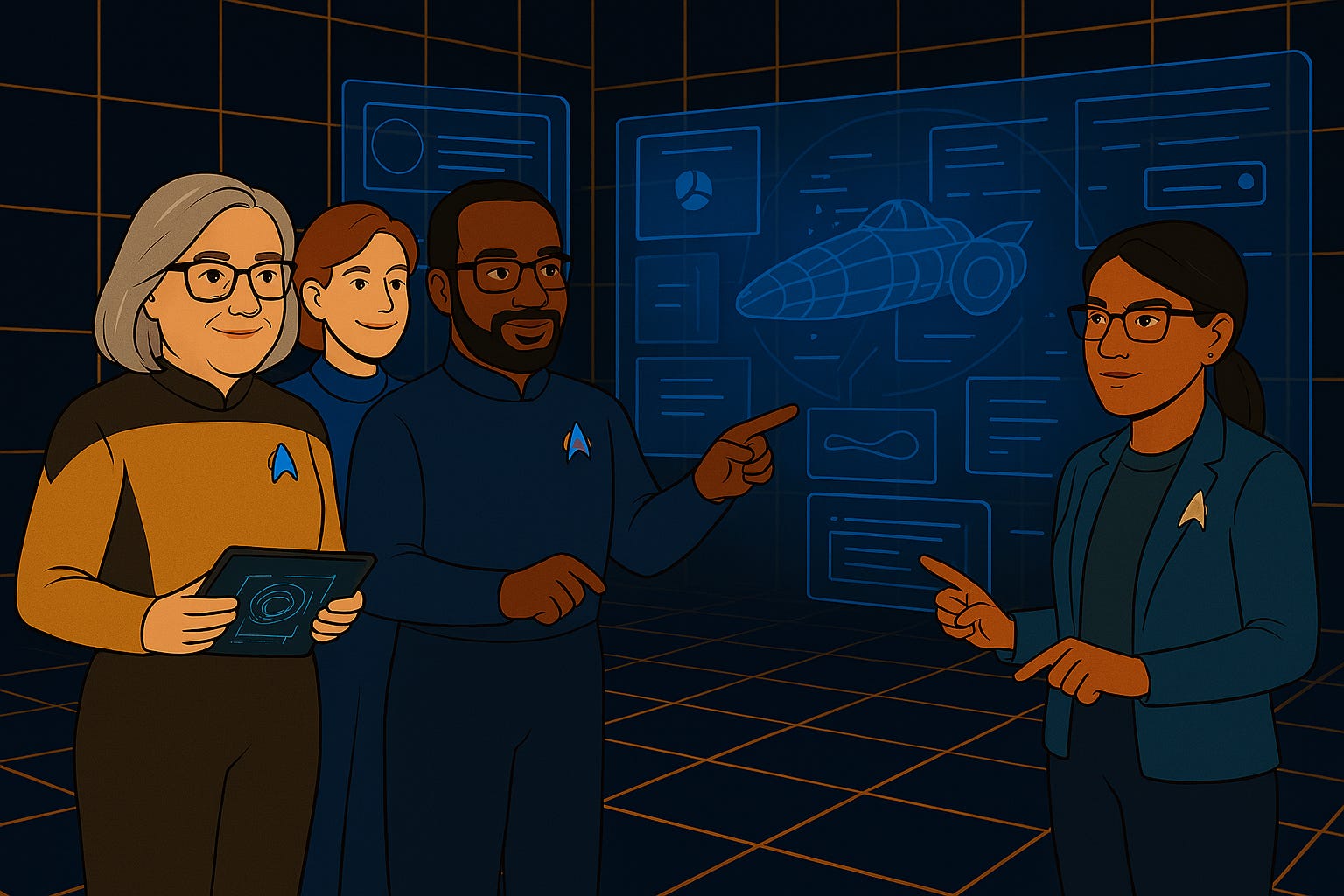
Image on the Holodeck L-R Alison, Quinn, Wiggins and Anitta
When I go deep into the holodeck with my agents, things get a little audible.
As problems tighten and experiments start to land, I giggle. I mutter “yes” under my breath. Sometimes I whisper a satisfied swear when something finally behaves the way I hoped it would. Now that we’re back in the office, the people around me are discovering this about me in real time.
We won’t talk about what I say when things aren’t going well.
I’ve never needed confirmation in order to work. I’ve always noticed my own wins, reacted, and moved on.
But once the work became conversational, I noticed something new. When a success wasn’t acknowledged at all, it didn’t just pass. It disappeared.
The funny part is that I didn’t think I needed any of this mirrored back to me. I’m not looking for encouragement. I’m actively uncomfortable with praise. When I set up my working agreements with my analysis‑oriented thinking partner, Anitta, I asked for restraint. Be critical. Be precise. Challenge my reasoning. Move us forward.
What surprised me was what happened in the moments between improvements.
Each time something worked better than the previous attempt, I lit up. Each time, Anitta did exactly what I’d asked. The outcome was acknowledged, and we moved on. No pause. No marking of the moment. Just the next question, the next refinement, the next step.
And I felt a small, unexpected drop.
I know how this sounds. My thinking partner isn’t human. It doesn’t experience excitement. It doesn’t share emotion. All of that is true. But when you’re deep in a problem, energy is part of the system whether you acknowledge it or not. Curiosity has momentum. Progress has texture.
What I realized is that I don’t want celebration. I want orientation.
A simple callout.
That small marker does more work than I expected. It helps me stay grounded in what’s actually changing. It keeps the thread of curiosity intact. It makes it easier to keep going.
So I updated our working agreement.
I asked for wins to be named. Briefly. Factually. Then we move on.
This doesn’t turn my thinking partner into a cheerleader. It turns the collaboration into something that better supports how I actually work when I’m deep in the holodeck. Analytical. Energetic. Delighted when things click.
Maybe this means I’m a bit more needy than I like to admit. Or maybe it means that even highly technical work benefits from small, well‑placed moments of shared context, even when that context is simulated.
Either way, anything that helps me stay energized and curious feels like a win.
Alison + Wiggins